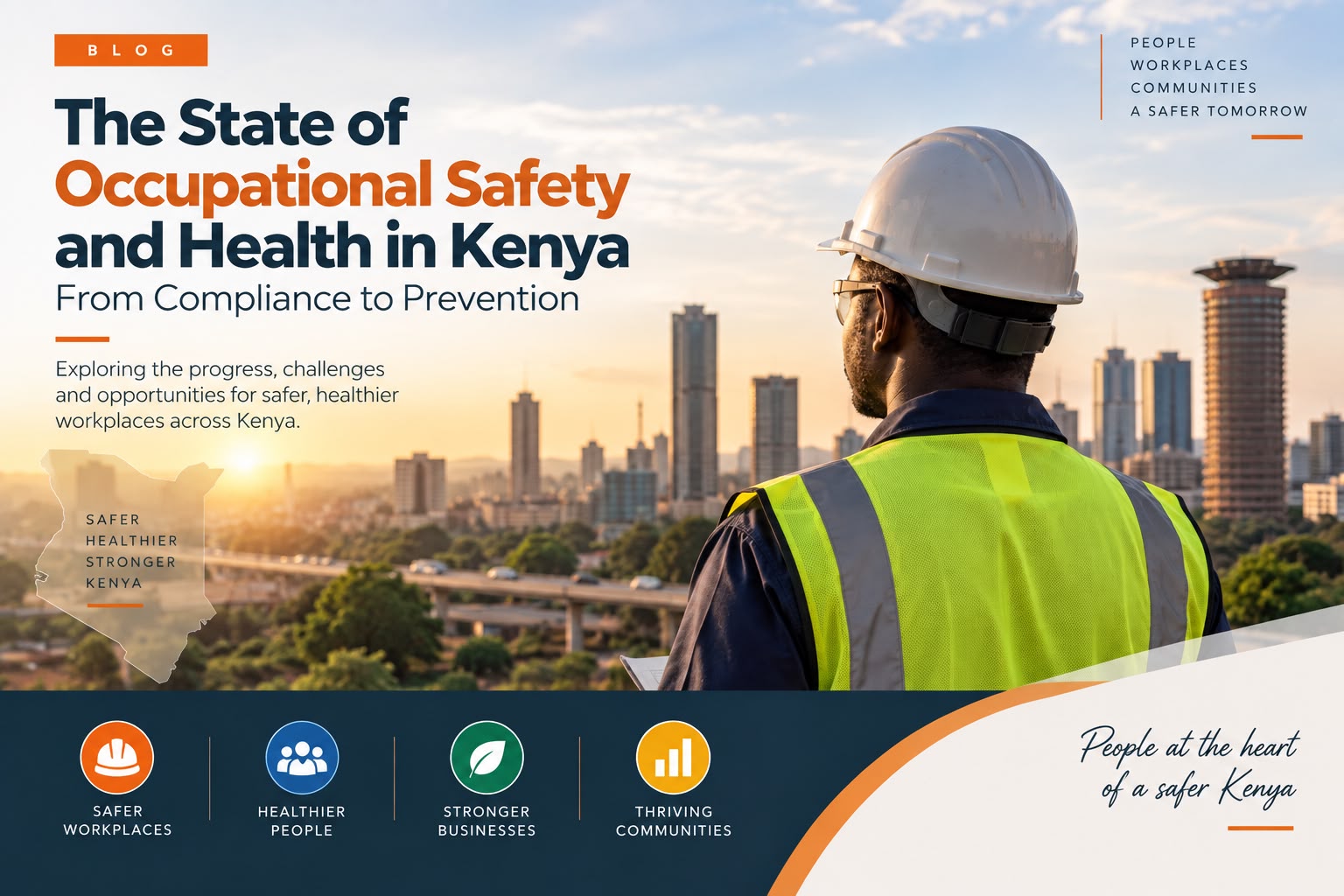

Occupational Safety and Health (OSH) in Kenya is becoming increasingly important as workplaces continue to evolve, industries expand and organisations become more aware of the relationship between employee wellbeing and business performance.
For many years, workplace safety was often viewed primarily through the lens of compliance. Employers focused on meeting regulatory requirements, conducting inspections and responding to incidents when they occurred.
Today, there is a growing need for a different approach.
The future of workplace safety in Kenya must be built around prevention.
Understanding OSH in Kenya
Kenya has an established legal framework for protecting workers through the Occupational Safety and Health Act, 2007, together with various subsidiary regulations.
The Directorate of Occupational Safety and Health Services (DOSHS), under the Ministry of Labour and Social Protection, plays a central role in implementing and enforcing occupational safety and health requirements. Its responsibilities include workplace inspections, investigation of occupational accidents and diseases, workplace monitoring, medical examinations and health surveillance, OSH training and dissemination of safety information. (Ministry of Labour)
However, legislation and inspections alone cannot create safe workplaces.
Safety is ultimately shaped by what happens every day.
The Changing Kenyan Workplace
Kenya’s workforce spans a wide range of sectors, including manufacturing, agriculture, construction, healthcare, transport, hospitality, logistics, education, offices and emerging technology industries.
Each environment presents its own risks.
A factory worker may be exposed to excessive noise, machinery and chemicals. An agricultural worker may encounter pesticides, machinery and physical strain. A construction worker may face falls, dust, noise and hazardous equipment.
Even office environments have occupational health considerations, including prolonged sitting, poor ergonomics, visual strain, stress and other factors that can affect employee wellbeing.
This means there is no single OSH solution that works for every organisation.
Effective occupational health begins with understanding the specific risks associated with the work.
From Reactive to Preventive Safety
One of the biggest opportunities for organisations in Kenya is to move away from a reactive approach.
A reactive workplace asks:
“What do we do after something goes wrong?”
A preventive workplace asks:
“What can we do to stop it from going wrong in the first place?”
That difference can have a significant impact.
Regular workplace risk assessments, employee health surveillance, occupational medical examinations, safety training and effective emergency preparedness can help organisations identify problems before they become serious incidents.
For example, hearing assessments can identify changes in hearing among employees exposed to occupational noise. Spirometry can help assess lung function where workers may be exposed to respiratory hazards. Vision and musculoskeletal assessments can identify concerns that may affect an employee’s ability to safely perform their duties.
The objective is not simply to identify problems.
It is to identify risks early and act on them.
Occupational Health Is More Than Medical Examinations
Occupational health is sometimes reduced to an annual medical examination.
But effective occupational health is much broader.
It involves understanding the relationship between:
The worker.
The workplace.
The hazards.
The work being performed.
And the potential impact on health.
This is why occupational health programmes can include medical examinations, health surveillance, workplace assessments, exposure monitoring, health education and appropriate interventions.
Kenya’s Ministry of Labour has also developed draft national guidelines on occupational medical examinations, reflecting the growing emphasis on structured and preventive occupational health practices. (Ministry of Labour)
Safety Is a Management Responsibility
A strong safety culture starts at the top.
Employees are more likely to take safety seriously when management demonstrates that safety is genuinely important.
This means providing appropriate protective equipment, investing in training, responding to identified risks, maintaining equipment, encouraging incident reporting and ensuring that employees understand their responsibilities.
Safety should not belong exclusively to the safety officer.
It should be part of management, human resources, operations and everyday decision-making.
The Cost of Ignoring Workplace Health
Workplace incidents can have consequences that extend far beyond the immediate injury.
An incident can result in:
- Lost productivity
- Employee absence
- Medical expenses
- Equipment or property damage
- Operational disruption
- Compensation claims
- Regulatory consequences
- Reputational damage
- Reduced employee morale
Prevention therefore makes both human and business sense.
A safe workplace protects employees while also protecting the organisation’s ability to operate effectively.
The Role of Employees
Safety is not only an employer’s responsibility.
Employees also have an important role to play.
They should understand workplace hazards, follow established safety procedures, use protective equipment correctly, report unsafe conditions and participate actively in workplace health and safety programmes.
A successful OSH culture is built when employers and employees work together.
Where Kenya Needs to Go Next
The next chapter of occupational safety and health in Kenya should focus on moving beyond compliance towards a culture of prevention.
Organisations should increasingly ask:
Are we identifying risks early?
Are we monitoring the health of employees exposed to occupational hazards?
Are we learning from incidents and near misses?
Are our employees adequately trained?
Are our safety programmes actually reducing risk?
These questions shift the conversation from simply meeting requirements to creating workplaces where people can work safely and remain healthy throughout their careers.
Building Safer Workplaces Together
Occupational Safety and Health is ultimately about people.
Every workplace has someone who expects to return home safely at the end of the day. Every organisation has a responsibility to create an environment that supports that expectation.
Kenya has the laws, institutions and professional expertise needed to strengthen workplace safety. The next step is ensuring that OSH becomes deeply embedded in organisational culture and everyday operations.
The strongest organisations will not be those that simply respond to workplace incidents.
They will be the organisations that identify risks early, protect their people and continuously improve the way they work.
A safer workplace is not created by compliance alone. It is created by a culture of prevention, responsibility and care.
