
When people hear the words Occupational Safety and Health, they often picture construction sites, protective helmets, machinery, chemicals and workplace accidents.
These are important.
But some of the most significant workplace health risks are not always visible.
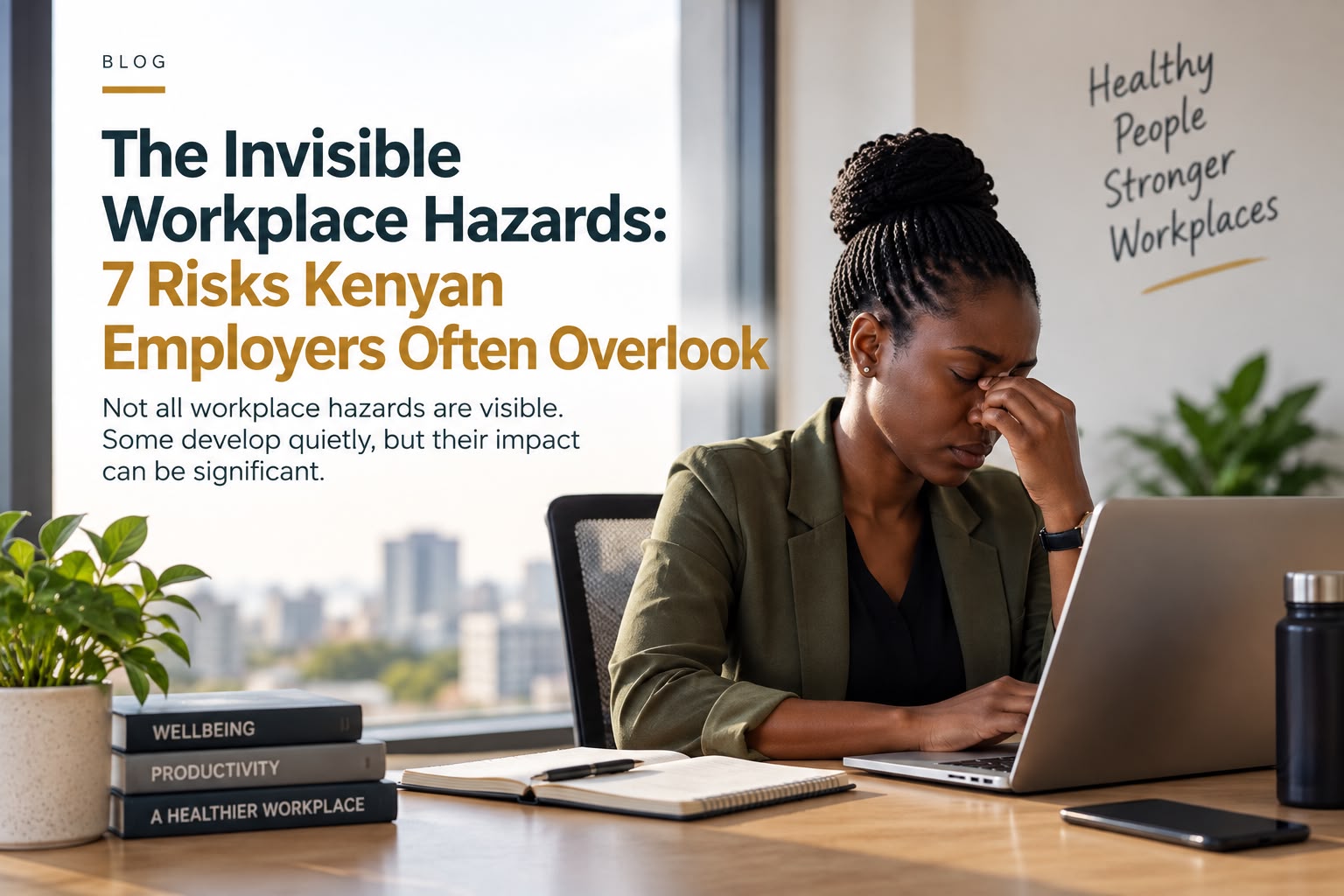
An employee sitting at a desk for eight hours may not appear to be exposed to a workplace hazard. Neither does an employee working in a call centre, laboratory, hospital, warehouse or retail environment.
Yet every workplace has risks.
Some are obvious. Others develop quietly over months or even years.
Understanding these less visible hazards is an important part of building a healthier and safer workplace in Kenya.
1. Poor Ergonomics
A poorly designed workstation can have a significant impact on an employee’s health.
Improper chair height, poorly positioned screens, inadequate desk space and repetitive movements can contribute to neck, shoulder, back and wrist discomfort.
The problem is that ergonomic risks rarely result in a dramatic incident. Instead, symptoms may develop gradually.
Organisations should therefore consider workstation design, employee posture, movement and work practices as part of their occupational health strategy.
2. Occupational Noise
Noise is not only a concern in factories and construction sites.
Employees can also experience significant noise exposure in workshops, manufacturing facilities, transport operations, entertainment venues, agricultural operations and other environments.
The danger is that hearing damage can develop gradually, sometimes without obvious symptoms in the early stages.
Regular hearing assessments and appropriate noise-control measures can help organisations identify and manage the risk.
3. Chemical Exposure
Many workplaces use chemicals every day.
Cleaning products, laboratory reagents, pesticides, solvents, fuels and industrial chemicals can all present occupational health risks when they are not properly controlled.
The risk is not necessarily limited to a major chemical spill.
Repeated low-level exposure, inadequate ventilation, incorrect storage or improper handling can also create health concerns.
Understanding what chemicals are present in the workplace, how employees interact with them and what controls are in place is essential.
4. Poor Indoor Air Quality
Air quality is an occupational health issue that can easily be overlooked.
Poor ventilation, dust, fumes, biological contaminants, chemicals and inadequate air circulation can affect employees, particularly those working in enclosed environments.
Employees may experience headaches, irritation, respiratory symptoms, fatigue or reduced comfort without immediately associating these problems with their workplace.
A healthy workplace starts with healthy air.
5. Visual Strain
Modern workplaces increasingly depend on computers, mobile devices and digital systems.
Employees can spend many hours looking at screens, often without adequate breaks or appropriate workstation arrangements.
Visual strain can contribute to discomfort, headaches and difficulty maintaining concentration.
Simple measures such as appropriate lighting, correct screen positioning, regular breaks and suitable visual assessments can make a meaningful difference.
6. Psychosocial Risks
Not every workplace hazard is physical.
Work-related stress, excessive workloads, poor communication, bullying, harassment, lack of control over work and unhealthy workplace cultures can affect employee wellbeing and performance.
Psychosocial risks are particularly important because they can be difficult to identify.
An employee experiencing stress may not report it as a workplace health concern.
Organisations therefore need to create environments where employees can raise concerns safely and where managers recognise the importance of psychological wellbeing.
7. Heat Stress
For employees working outdoors or in hot environments, heat can become a serious occupational concern.
Construction workers, agricultural workers, road crews, security personnel and other outdoor employees may spend long periods exposed to high temperatures.
Heat-related illness can affect concentration, physical performance and overall health.
Employers can reduce risk through appropriate work-rest arrangements, hydration, shade, education and monitoring of employees working in hot conditions.
The Biggest Risk May Be the One Nobody Notices
The most dangerous workplace hazard is not necessarily the one that looks the most dramatic.
Sometimes it is the risk that employees have simply become accustomed to.
A noisy workplace can become “normal.”
Poor posture can become “part of the job.”
Long working hours can become “the way things are done.”
Stress can become “just work.”
That is why effective occupational health requires more than responding to accidents.
It requires organisations to continually ask:
What could be affecting our employees that we are not seeing?
From Awareness to Action
Identifying a workplace hazard is only the beginning.
Organisations should assess the risk, determine who may be affected and introduce appropriate controls.
This can involve:
- Workplace risk assessments
- Occupational medical examinations
- Health surveillance
- Audiometry
- Spirometry
- Visual acuity testing
- Musculoskeletal assessments
- Exposure monitoring
- Employee health education
- First aid and emergency preparedness
- Regular review of workplace controls
The objective is simple:
Identify risks early. Control them effectively. Protect people.
A Safer Workplace Starts With Looking Beyond the Obvious
Occupational safety and health is not only about preventing accidents.
It is about creating working environments where people can perform their duties without unnecessary risks to their health, safety and wellbeing.
For Kenyan organisations, this means looking beyond the obvious hazards and paying attention to the risks that develop quietly.
Because sometimes, the workplace hazard that matters most is the one nobody is talking about.
Look beyond the incident. Look at the environment.
